Quand je me suis demandé quel plat je
pourrais faire pour représenter la cuisine coréenne, j'ai hésité
longuement… longuement… tant la cuisine coréenne est pour
moi riche et variée mais aussi malheureusement bien mal connue par
chez nous.

Et en réfléchissant à tout ce qui me
faisait envie j'ai pensé aux Kimbap ces roulés de riz entourés
d'algue, aux saveurs si parfumées et relevées, au Bulgogi ce "
barbecue " à la coréenne, ce joli ragoût de viande et de
légumes , aux Dak Kang Jung ces beignets de poulets couverts de
sauce qui parfois vous mettent les lèvres en feu, aux Pajeon ces
drôles de crêpes aux ciboules et aussi au Yukhoe un de mes tartares
préférés, que je vous ai déjà proposé par ici, au Riz frit au Kimchi… bien sûr au Kimchi, ce chou pimenté et surtout fermenté,
qui donne sa force et surtout son parfum à bien des plats et qui
montre une des particularités de la cuisine coréenne,
l'utilisation et la maitrise de la fermentation. J'ai pensé à ça
et à tellement d'autres plats… La cuisine coréenne est comme un
continent encore à découvrir par ici…
Et puis après avoir longtemps hésité,
je suis revenu à une de mes passions quand il s'agit de cuisine
coréenne, à ce plat que j'aime commander et recommander dans
les tables coréennes où je vais déjeuner ou préparer à la
maison, tant les amateurs ne manquent pas, le Bibimbap !
Pourquoi le Bibimbap ??? Sans doute
parce que j'aime les plats qui se mélangent et où finalement chacun
peut trouver son équilibre, parce que j'aime le Gochujang, cette
pâte de piment dont j'use et quelque fois j'abuse dans mes Bibimbap,
et peut être enfin parce que j'ai découvert avec Claire et que ça…
Et juste parce que j'aime ce mot Bibimbap qui claque sous la langue
comme la gourmandise, le Bibimbap donc !
Le Bibimbap est un drôle de plat
composé de riz, de Gochujang bien sûr, mais aussi de tellement
d'autres choses selon le goût du cuisinier ou de la cuisinière !
Shiitakes, épinards, viande et œuf, gosari, navet et courgette,
concombre et soja et carottes… Tout l'art du Bibimbap est dans le
mélange des ingrédients, ni trop, ni trop peu ! Parce qu'il ne faut
pas oublier que si le le Bibimbap commence bien rangé, bien ordonné,
c'est mélangé, bien bien mélangé que vous allez le déguster !
Et pour composer mon Bibimbap
j'ai eu envie de l'agrémenter d'un petit condiment au radis blanc,
au radis et au piment bien sûr !
Mon Bibimbap à moi !
Ingrédients pour deux : 1 beau bol de
riz cuit nature – 200g de viande hachée (de préférence au
couteau) – 1 gousse d'ail finement hachée - 6 shiitakes –
1 petite poignée de petits bouquets de brocoli – 2 petites
courgettes de couleurs différentes - 1 petite carotte - 1
petite poignée d'épinards cuits – 1 petite poignée de pousses de
soja - 2 œufs - de l'huile neutre - de la sauce soja – du
gochujang – de l'huile de sésame - 2ou 3 ciboules
Pour le condiment au radis : ½ radis
blanc – 1càc de sel – 1 càc de sucre en poudre – 1càc de
sauce à l'anchois – ½ càc de piment en poudre – 1càc de
graines de sésame – 2 ou 3 ciboules
Commencez en préparant le condiment. Taillez le radis en très fines
lanières, un peu comme si vous faisiez des carottes râpées avec
une râpe à gros trous. Mettez le radis dans un bol, ajoutez le
sucre et le sel et mélangez bien.Laissez mariner 10 mn, le radis va
rendre son eau.Rincez le radis, séchez-le bien puis
ajoutez la sauce à l'anchois, le piment, les graines de sésame et
les ciboules émincées. Mélangez bien le tout et réservez jusqu'au
montage du Bibimbap.
Préparez ensuite tous vos autres
ingrédients.
Emincez en très fins bâtonnets la
carotte et une courgette. Coupez l'autre courgette en très fins
triangles. Détaillez en tout petits bouquets les brocolis. Emincez
les ciboules. Faites ensuite cuire séparément
chaque ingrédient.
Faites chauffer une poêle à feu vif,
versez un filet d'huile et faites sauter rapidement les champignons
et les brocolis. Dès qu'ils commencent à dorer ajoutez 1càs de
sauce soja et une belle pincée de sucre en poudre, prolongez la
cuisson d'une minute juste le temps que la sauce soit absorbée par
les légumes. Réservez.
Faites chauffer la poêle toujours à
feu vif, versez un filet d'huile et ajoutez les courgettes, sans
mélanger les deux variétés. Faites-les sauter pendant 2 à 3
minutes. Ajoutez un petit filet d'huile de sésame en toute fin de
cuisson. Réservez.
Faites de même avec le soja.
Faites chauffer la poêle toujours à
feu vif, versez un filet d'huile et ajoutez la viande. Emiettez-la en la faisant rapidement
revenir. Ajoutez l'ail, remuez bien en
continuant d'émietter la viande.
Ajoutez une belle cuillère de sauce
soja et une càc de sucre en poudre, ajustez en sel et poivrez, vous
pouvez aussi éventuellement parfumer votre viande avec un peu de
gingembre frais râpé ou de gochujang, et prolongez la cuisson
jusqu'à ce que la viande soit bien cuite. Ajoutez un petit filet
d'huile de sésame en toute fin de cuisson. Réservez.
Faites réchauffer rapidement les
épinards dans la poêle. Réchauffez le riz au micro-ondes. Faites frire très rapidement les œufs.
Préparez le Bibimbap.
Placez le riz au fond d'un plat. Placez dessus une belle cuillère à
soupe de gochujang, puis l'œuf et répartissez ensuite autour de
l'œuf, les shiitakes aux brocolis, la viande, les courgettes, la
carotte, les germes de soja, les épinards, le condiment au radis.Parsemez par-dessus un peu de ciboule
et quelques graines de sésame à votre goût.Et là mélangez, mélangez, mélangez…
Servez avec de la sauce soja et du Gochujang et mangez sans attendre
!
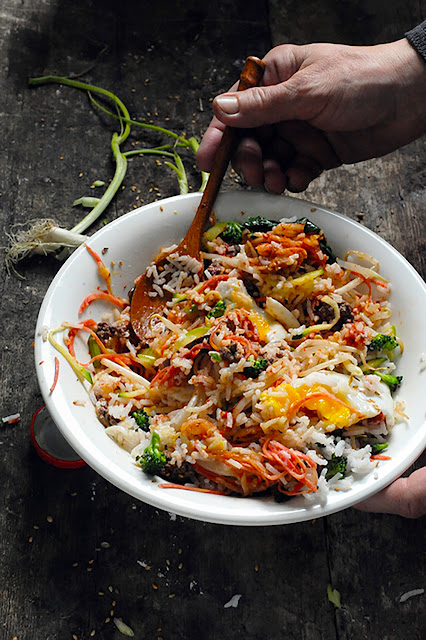
Bibimbap my way
Ingredients for 2: 1
bowl cooked plain rice - 200g ground meat (preferably with a sharp
knife) - 1 clove of garlic finely chopped - 6 shiitakes mushrooms - 1
small handful broccoli florets - 2 small zucchinis of different
colours - 1 small carrot - 1 small handful cooked spinach - 1 small
handful bean sprouts - 2 eggs - vegetable oil - soy sauce - gochujang
- sesame oil - 2 or 3 scallions
For the radish condiment: 1/2
white radish - 1 tsp salt - 1 tsp caster sugar - 1 tsp anchovy sauce
- 1/2 ground hot chilli pepper - 1 tsp sesame seeds - 2 or 3
scallions
Start with the radish condiment.
Cut the radish into
thin ribbons, using a coarse grater like for shredded carrots.
Put
in a bowl and mix with the salt and sugar.
Let marinate for 10
minutes. It will lose water.
Rinse the radish, dry it and add the
anchovy sauce, pepper, sesame seeds and sliced scallions. Mix well
and set aside.
Then, prepare all the other ingredients.
Cut one
zucchini and the carrot into fine matchsticks. Cut the other zucchini
into triangles. Cut the broccoli into tiny florets. Slice the
scallions. Cook each ingredient separately.
Heat up a pan on high
heat, pour a lug of oil and quickly sauté the mushrooms and
broccoli. When they start to brown, add a tablespoon of soy sauce and
a large pinch of sugar. Keep cooking for another minute until the
veggies absorbed all the sauce. Set aside.
Put the pan back on
high heat with a lug of oil and add the zucchini, without mixing the
2 kinds. Sauté for 2 or 3 minutes and drizzle a little bit of sesame
oil at the very end. Set aside.
Do the same with the bean
sprouts.
Heat up the pan on high heat, add a lug of oil and add
the meat.
Crumble it while you sauté it.
Add the garlic and
keep stirring to separate all the pieces of meat from one
another.
Add a large tablespoon of soy sauce and a teaspoon of
sugar. Check the seasoning and add salt and pepper if needed. You
could also add some grated fresh ginger or gochujang. Keep cooking
until the meat is done. Drizzle some sesame oil at the very end and
set aside.
Quickly heat up the spinach in the pan.
Heat up the
rice in the microwave.
Very quickly fry the eggs.
Put up the
Bibimbap.
Place the rice in the bottom of the dish.
Place a
tablespoon of gochujang on top, then the egg and place the shiitake
mushrooms and broccoli around, as well as the meat, the zucchini,
carrot, bean sprouts, spinach and radish condiment.
Sprinkle some
scallions and sesame seeds to your taste.
And now, mix and mix and
mix and mix… and serve immediately, with soy sauce and gichujang.

Mais pourquoi, et si le Bibimbap
devenait le plat de l'année… est-ce que je vous raconte ça…


